India, being one of the world’s largest developing economies, is currently undergoing rapid urbanisation, driven by a young population and rising aspirations of middle-class households for home ownership and improvement. These structural shifts are acting as strong tailwinds for the country’s real estate sector, which in turn fuels growth in the furniture industry. With nearly 65% of India’s furniture market consisting of wood-based furniture, the rising demand for furniture directly drives the demand for wood panel products such as plywood, medium-density fibreboard (MDF) and particleboard.
However, import data from recent years points to a significant and growing reliance on imports, indicating the domestic industry’s limited ability to ramp up production quickly. In FY 2024–25, India imported plywood and panel products worth ₹3,431 crore, registering a strong compound annual growth rate (CAGR) of over 14% over the last five years. This sharp increase highlights the significant demand-supply gap that developed in the Indian wood panel market during this period.
While the sharp rise in wood panel imports in recent years has been primarily driven by the growing demand-supply gap in the market, a significant portion of these imports consisted of sub-standard products. These low-quality wood panels were often dumped in large quantities at substantially lower prices by foreign manufacturers. This not only posed risks to consumers who use end-products made from such inferior materials but also created an unfair playing field for domestic manufacturers who focus on quality.
To address these challenges, the Government of India introduced regulatory measures by implementing mandatory Quality Control Orders (QCOs) on plywood and panel products, effective from February 2025. Under these orders, all plywood and panel imports entering India from March 2025 onwards must comply with Bureau of Indian Standards (BIS) certification requirements. Only consignments originating from manufacturers holding a valid BIS license are eligible for import, ensuring that products meet minimum quality and safety standards.
The primary objective of this study is to assess the effectiveness of the QCOs implemented in February 2025, particularly in determining whether they have succeeded in restricting imports from foreign manufacturers lacking valid BISlicenses. In addition, the study aims to identify specific aspects related to non-compliant imports, including the top source countries involved, the major Indian ports receiving such shipments, the product categories under which these consignments are entering and the foreign manufacturers associated with them.
The scope of this study is limited to three major categories of wood panel products — plywood, medium-density fibreboard (MDF) and particle board. The analysis covers month-wise import data from March 2025 to August 2025, representing the immediate post-QCO implementation period.
During the last financial year, in the months leading up to the implementation of the QCOs, monthly imports of plywood (products classified under HSN Code 4412) were on a sharp upward trend. This surge was primarily driven by the large-scale dumping of sub-standard products, as mentioned earlier. The substantial import values recorded in January and February 2025 reflect aggressive stockpiling by importers ahead of the regulatory enforcement.
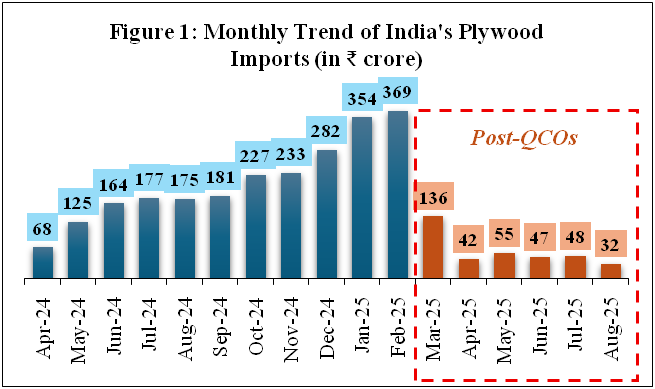
However, monthly import figures sharply declined following the implementation of the QCOs. Plywood imports dropped to ₹136 crore in March and continued to decline in the subsequent months — ₹42 crore in April, ₹55 crore in May, ₹47 crore in June, ₹48 crore in July and ₹32 crore in August 2025.
Following the implementation of the QCOs, India imported plywood products worth ₹361 crore between March and August 2025. Notably, nearly 81% of these post-QCO imports — valued at approximately ₹294 crore — originated from just three countries: Nepal, Vietnam and China.
Nepal emerged as the leading source, accounting for 32% of India’s total plywood imports during this period. It was closely followed by Vietnam with a 31% share, while China held the third position with 18% of the total imports.
However, according to the BIS website, only nine plywood manufacturers — all based in Nepal — have been granted BIS licenses so far. This stark contrast raises serious questions about how consignments from countries other than Nepal continue to enter India despite the mandatory licensing requirements under the QCOs. What is more concerning is that Vietnam and China remain the top source countries for India’s plywood imports in the post-QCO period, despite no manufacturer from either country having been issued a BIS license for any category of plywood.
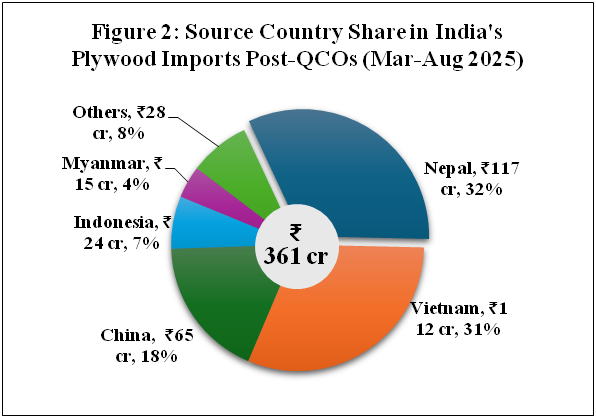
Key Takeaway: Despite no manufacturer from Vietnam or China being issued a BIS license for any category of plywood, both countries continue to remain top source countries for India’s plywood imports in the post-QCO period — raising serious questions about the enforcement mechanisms of the QCOs.
2.2.1 Plywood Imports from Vietnam in the Post-QCOs Era
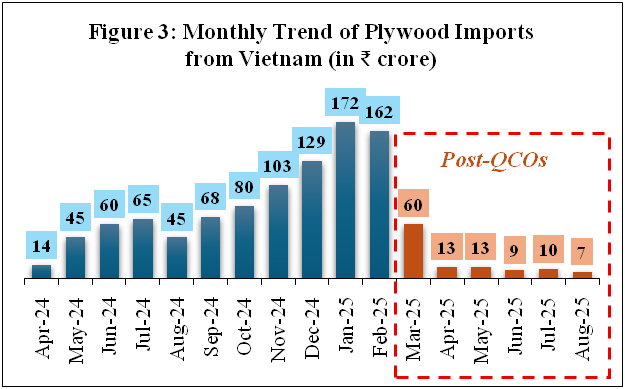
The month-wise trend of plywood imports from Vietnam shows that imports substantially declined following the implementation of the QCOs. Plywood imports fell to ₹60 crore in March and further declined to ₹13 crore each in April and May, ₹9 crore in June, ₹10 crore in July and ₹7 crore in August 2025. However, all such imports that arrived in the post-QCOs period were non-BIS-compliant, as no plywood manufacturer from Vietnam has been issued a BIS license for any category of plywood.
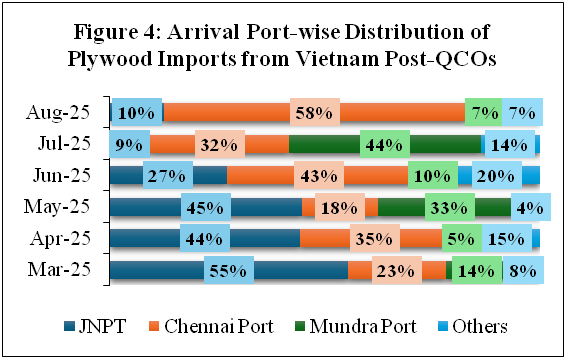
There have been significant month-wise shifts in the major Indian arrival ports for plywood imports from Vietnam during the post-QCOs period. In March 2025, Jawaharlal Nehru Port (Nhava Sheva) in Navi Mumbai was the largest entry point, accounting for nearly 55% of Vietnam’s plywood shipments to India. However, by August 2025, Chennai Port had emerged as the leading entry point, handling approximately 58% of total plywood imports from Vietnam.
The product-wise distribution of plywood imports from Vietnam shows that a vast majority of these imports have consistently been classified under the ‘Others’ sub-category of HSN Code 4412 during the post-QCOs period. In August 2025, approximately 82% of plywood imports from Vietnam were classified under the ‘Others’ sub-category, primarily under HSN Codes 44123190, 44123490 and 44129990.
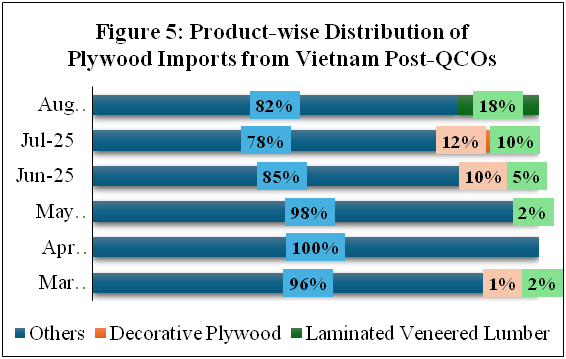
The following table lists Vietnam-based plywood manufacturers without BIS licenses whose consignments were cleared at Indian entry points in August 2025, despite the QCOs being in place.
| 1. 368 Plywood Import Export Joint Stock Co. | 2. Alphawood Vietnam Joint Stock Co. | 3. An Lam | 4. Bright Vina Plywood |
| 5. Hung Dung Hth Production & Trading | 6. Longdat Import-Export & Production | 7. TCQ | 8. TT Plywood Import Export & Trading |
| 9. Vinacamon Joint Stock Co. | 10. Wood Alliance Production |
Table 1: List of Vietnam-Based Plywood Manufacturers Without BIS Licenses Whose Consignments Were Cleared at Indian Entry Points in August 2025
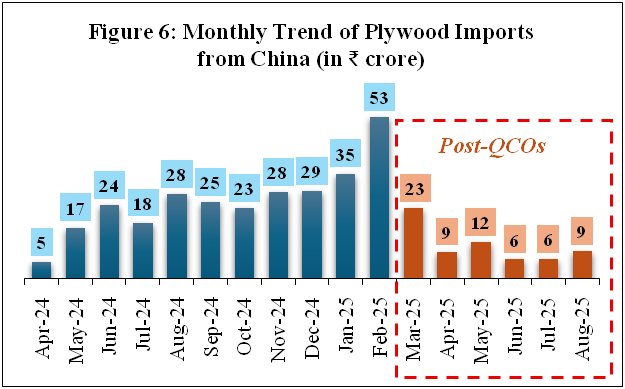
Similar to the plywood imports from Vietnam, imports of plywood from China declined sharply following the implementation of the QCOs. Plywood imports from China fell to ₹23 crore in March 2025, further decreasing to ₹9 crore in April, ₹12 crore in May, ₹6 crore each in June and July and ₹9 crore in August 2025. Notably, all such imports from China during the post-QCOs period were non-BIS-compliant, as no plywood manufacturer from China has been granted a BIS license for any plywood category.
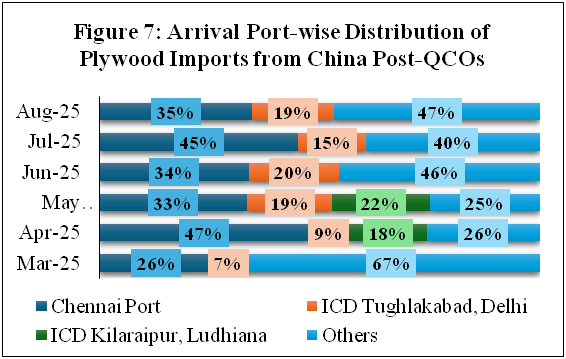
Furthermore, the arrival port-wise distribution of plywood imports from China during the post-QCOs period indicates that Chennai Port consistently remained the largest entry point for these imports. In August 2025, Chennai Port alone handled approximately 35% of plywood consignments arriving from China. It was followed by the Inland Container Depot (ICD) Tughlakabad in Delhi, which handled about 19% of the total plywood consignments from China during the same month.
Similar to the trends observed in Vietnam, the product-wise distribution of plywood imports from China during the post-QCOs period shows that a vast majority of these imports have consistently been classified under the ‘Others’ sub-category of HSN Code 4412. In August 2025, nearly 77% of plywood imports from China were classified under the ‘Others’ sub-category, primarily under HSN Codes 44123390, 44129990 and 44123990.
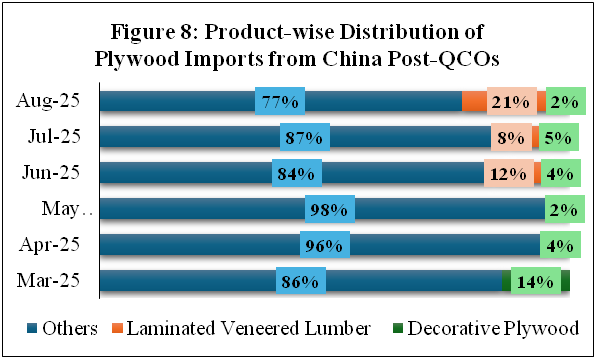
The following table lists China-based plywood manufacturers without BIS licenses whose consignments were cleared at Indian entry points in August 2025, despite the QCOs being in place.
| 1. Accahome Ltd | 2. Beijing Graphic International Trade | 3. Fuzhou Hongland Model | 4. Guangzhou Jiuyuekang Medical Equipment |
| 5. Heze Ruidu International Trade | 6. Hongkong Qichuang Wooden Products | 7. Huzhou Jonhos Creative Home | 8. Huzhou ShitoHomie |
| 9. Huzhou Teya Floor | 10. Huzhou Weiya Trading | 11. Jinemen Dier Wooden Industry | 12. Jining Floormaker |
| 13. Linyi Chunchang International Trade | 14. Linyi Huanhai International Trade | 15. Max Choice Wood Industry | 16. Shandong Changsen Import & Export |
| 17. Shandong King Kong Industry | 18. Suqian Sulu Import & Export Trading | 19. Xiang Ou Trade | 20. Xuzhou Emmet Import & Export |
| 21. Zhejiang Yi Yang International Trade |
Table 2: List of China-Based Plywood Manufacturers Without BIS Licenses Whose Consignments Were Cleared at Indian Entry Points in August 2025
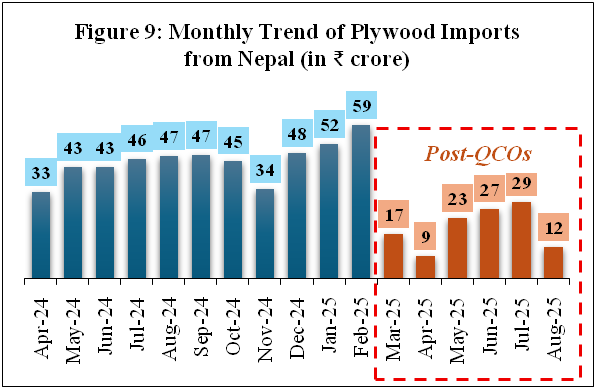
Similar to the trends observed in plywood imports from Vietnam and China, monthly plywood imports from Nepal remained relatively low during the post-QCO period compared to the pre-QCO months. Imports declined to ₹17 crore in March 2025, further dropping to ₹9 crore in April before rising to ₹23 crore in May, ₹27 crore in June, ₹29 crore in July and then falling to ₹12 crore in August 2025.
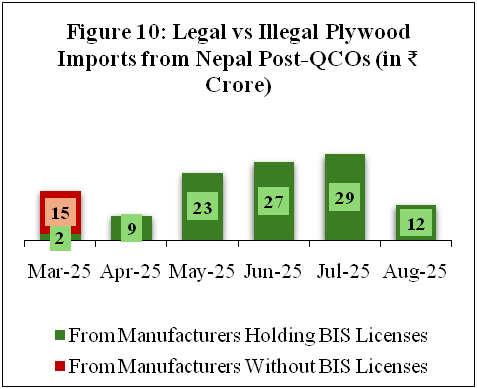
Notably, in March 2025, despite the QCOs being in effect, approximately 88% of total plywood imports from Nepal—amounting to nearly ₹15 crore—originated from 30 manufacturers lacking valid BIS licenses. However, from April 2025 onwards, all plywood imports from Nepal were sourced exclusively from manufacturers holding valid BIS licenses, indicating full BIS compliance during the subsequent months.
The following table lists Nepal-based plywood manufacturers who have been issued BIS licenses for plywood.
| 1. Ambey Bhawani Ply Board Udhyog | 2. Bhusal Ply & Bamboo Industries | 3. Century Ply Industries | 4. Everest Veneers |
| 5. Ganpati Veneer Tatha Plywood Udhyog | 6. Greenply Industries Nepal | 7. Jhapa Veneer and Plywood Udhyog | 8. Sawariya Plywood |
| 9. Shyam Plywood Industries |
Table 3: List of Nepal-Based Plywood Manufacturers Holding BIS Licenses for Plywood
During May, June and July 2025, compared with previous months, an abnormal surge was observed in plywood exports to India from the 9 Nepal-based companies holding BIS licenses. This pointed to a strong possibility that non-BIS-compliant plywood was entering India under the cover of certified material. However, in August 2025, a declining trend in plywood imports from Nepal (or from those 9 manufacturers holding BIS licenses) suggests that compliance mechanisms have started being enforced more strictly.
During the last financial year, in the months leading up to the implementation of the QCOs, monthly imports of medium-density fibreboard (MDF), classified under HSN Code 4411, remained at elevated levels. Import figures surged significantly to ₹103 crore in January and ₹88 crore in February 2025, driven primarily by substantial stockpiling by importers ahead of the QCO enforcement deadline.
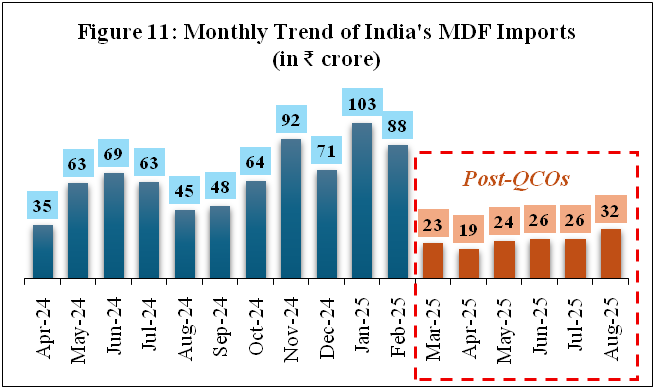
However, similar to the trends observed in the plywood segment, monthly imports of MDF declined in the post-QCO period compared to pre-QCO levels. India imported MDF worth ₹23 crore in March, ₹19 crore in April, ₹24 crore in May, ₹26 crore in both June and July, and ₹32 crore in August 2025.
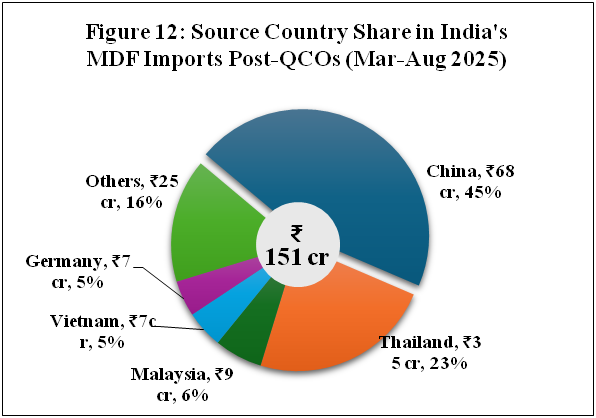
In the post-QCO period between March and August 2025, India imported MDF worth ₹151 crore. Notably, nearly 69% of these imports originated from just two countries — China and Thailand. During this period, China emerged as the leading source, accounting for approximately 45% of total MDF imports, followed by Thailand with a 23% share.
However, according to the BIS website, only two manufacturers — one based in Thailand and another in Malaysia — have been granted BIS licenses for MDF so far. This stark contrast raises serious questions about how consignments from countries other than Thailand and Malaysia, particularly China, continue to enter India despite the mandatory QCOs being in place.
The following table lists foreign manufacturers that have been issued BIS licenses for MDF.
Key Takeaway: Despite no manufacturer from China being issued a BIS license for any category of MDF, China remains the top source country for India’s MDF imports in the post-QCO period—raising serious concerns about the enforcement of the QCOs.
| 1. Vanachai Panel Industries (Thailand) | 2. Robin Resources (Malaysia) |
Table 4: List of Foreign Manufacturers Holding BIS Licenses for MDF
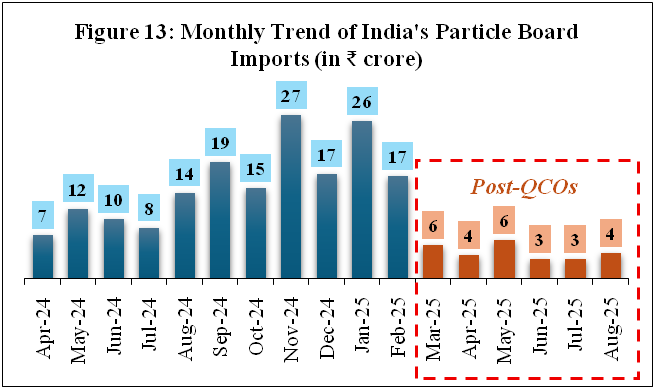
Similar to the trends observed in the plywood and MDF segments, imports of particle board (classified under HSN Code 4410) also followed a similar pattern. Compared to pre-QCO levels, monthly imports of particle board declined during the post-QCOs period. India imported particle board worth ₹6 crore in March, ₹4 crore in April, ₹6 crore in May, which then fell to ₹3 crore in both June and July, before rising slightly to ₹4 crore in August 2025.
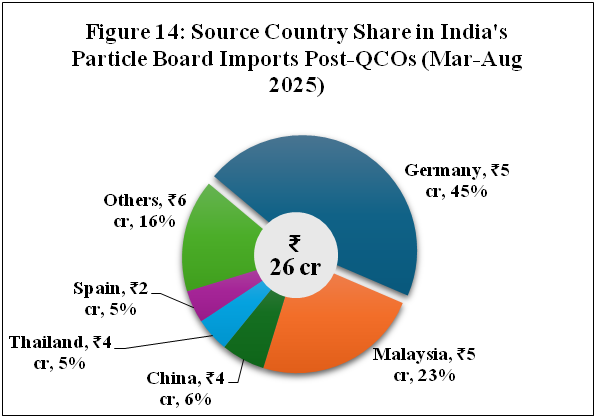
In the post-QCOs period between March and August 2025, India’s imports of particle board amounted to ₹26 crore. Notably, the top two source countries—Germany and Malaysia—accounted for a significant 69% share of India’s total particle board imports during this period.
During this period, approximately 45% of total particle board imports originated from Germany, establishing it as the leading source country in the post-QCOs period, followed by Malaysia, which accounted for a 23% share. However, according to the BIS website, no foreign manufacturer has been granted a BIS license for any category of particle board to date. This implies that all particle board consignments entering India during the post-QCO period were non-BIS-compliant. This stark discrepancy raises serious questions about how particle board consignments worth ₹26 crore entered India between March and August 2025, despite the absence of valid BIS licenses for any foreign manufacturers in this category.
Key Takeaway: Despite no foreign manufacturer being issued a BIS license for any category of particle board, India imported particle board worth ₹26 crore during the post-QCO period (March–August 2025), raising serious concerns about the effectiveness of QCO enforcement mechanisms.
This study reveals mixed results regarding the effectiveness of the QCOs in restricting imports from foreign manufacturers lacking valid BIS licenses. While import levels across all three segments—plywood, medium-density fibreboard (MDF) and particle board—have declined in the post-QCOs era compared to the pre-QCOs period, a deeper analysis uncovers significant discrepancies.
In both the plywood and MDF segments, a substantial portion of imports arriving in India after the QCOs enforcement in February originated from foreign manufacturers without valid BIS licenses, rendering these consignments non-BIS-compliant. The particle board segment presents even more concerning findings: with no foreign manufacturer issued a BIS license to date, all particle board imports post-QCOs implementation have been non-compliant.
These findings indicate that, although some progress has been made in curbing the entry of substandard plywood and panel products into the Indian market, the QCOs are far from fully effective. To ensure the QCOs achieve their intended objectives, it is imperative to strengthen enforcement mechanisms and address existing loopholes that continue to permit non-compliant imports.
