
Plywood and Panel Imports in the Post Quality Control Orders (QCOs) Era
 January 1, 2026
1. Overview
1.1 India’s Plywood and Panel Import Landscape
Over the past decade, the Indian wood-based industry has firmly established itself as a vital pillar of the country’s economic framework, underpinning sectors such as construction and real estate. This industry encompasses a wide array of activities, including logging, sawmilling, manufacturing of wood panels and the production of finished goods like furniture.
In the context of India’s Plywood and Panel Industry, global trade is not merely a support function – it forms the foundation of the industry’s structure. The growing demand for wood panels – driven by the government push for real estate development and its ambition to position India as a global furniture manufacturing and export hub – has outpaced the sector’s ability to ramp up production capacity quickly. As a result, a significant share of domestic needs continues to be met through imports.
India imported wood panel (plywood, MDF and particle board combined) worth INR 3,431 crore in FY 2024 – 25, reflecting a strong compound annual growth rate (CAGR) of approximately 14.6% over the past five years. Notably, plywood accounted for nearly 73% of these imports, highlighting a significant gap between domestic production and the country’s growing demand for plywood.
1.2 Implementation of the Quality Control Orders (QCOs)
In the recent years, a significant portion of India’s wood panel imports has been characterized by substandard products, often dumped at significantly lower prices by foreign manufacturers. This influx has placed the domestic manufacturers at a severe disadvantage and posed safety risks to end consumers using finished products made from such inferior materials.
To address these concerns – ensuring consumer protection and creating a level playing field for domestic manufacturers – the Government of India introduced the Quality Control Orders (QCOs) for plywood and other wood-based boards, effective from February 2025. Specifically, the ‘Plywood and Wooden flush door shutters (Quality Control) Order, 2024’ came into effect on 28th February 2025 and the ‘Wood Based Boards (Quality Control) Order, 2024’ became effective on 11th February 2025.
Regarding imports, following the implementation of the QCOs, only plywood and panel products from manufacturers with valid Bureau of Indian Standards (BIS) licenses are permitted to be exported to India.
1.3 Objective and Scope of the Study
The primary objective of this study is to examine the effectiveness of the recently introduced QCOs. Specifically, it aims to determine whether plywood and panel products entering India after the implementation of the QCOs originate exclusively from manufacturers holding BIS licenses. To analyse the post QCOs scenario, the study considers import data from the three-month period following the enforcement of the QCOs – March, April and May 2025.
Additionally, the study aims to identify specific patterns related to non-compliance, including the top source countries involved, major Indian ports receiving such shipments and key foreign manufacturers associated with non-compliant imports.
PLYWOOD
2. Analysis of Plywood Imports Following the Implementation of the QCOs
2.1 Monthly Trends in Plywood Imports to India
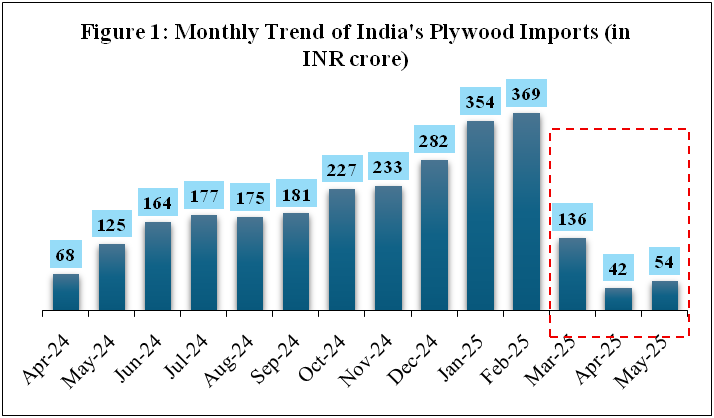
The month-wise trend analysis of India’s plywood imports during FY 2024-25 (as shown in Figure 1) reveals some noteworthy patterns. At the beginning of the financial year, India imported plywood worth INR 68 crore in April 2024, which surged more than five-fold to INR 369 crore by February 2025, just before the implementation of the QCOs. This sharp rise in imports can be attributed to two key factors – first, a surge in shipments containing substandard products, particularly from China; and second, large-scale stockpiling by Indian importers ahead of the QCOs enforcement deadline.
Following the implementation of the QCOs, India’s plywood imports stood at a reduced level of INR 136 crore in March, which further dropped to INR 42 crore and INR 54 crore in April and May 2025, respectively. At first glance, the decline in import figures suggests that the QCOs are effectively restricting the entry of plywood products into India that originate from foreign manufacturers without BIS licenses. However, considering that very few foreign manufacturers have been granted BIS licenses so far, these import volumes still appear relatively high, indicating that some non-BIS-compliant products may continue to enter India even after the enforcement of the QCOs.
2.2 Major Source Countries for India’s Plywood Imports in the Post QCOs Era
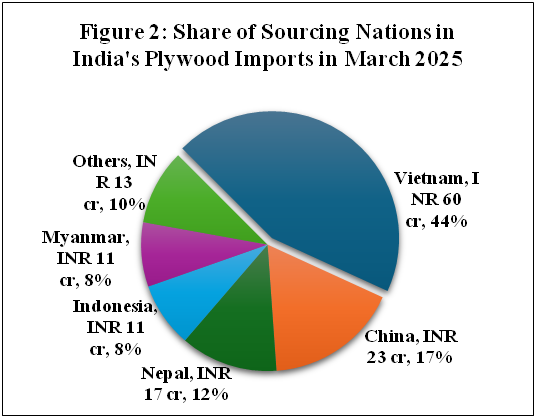
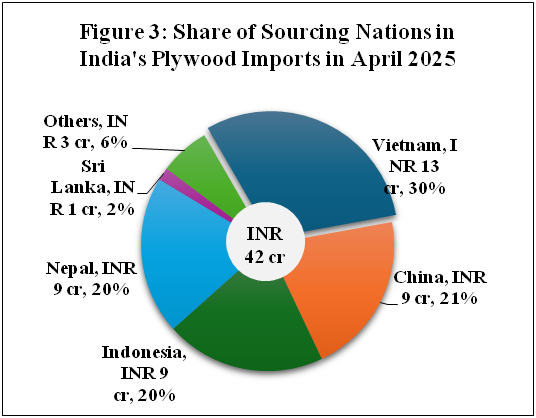
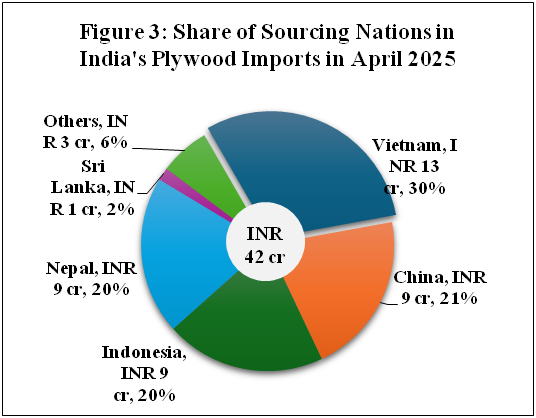
The source-country distributions of India’s plywood imports for March, April and May 2025 are presented in Figures 2, 3 and 4.
In March 2025, Vietnam emerged as the top source country for India’s plywood imports, accounting for a substantial 44% share of total shipments, valued at INR 60 crore. It was followed by China and Nepal, with 17% and 12% shares of total imports, respectively. Vietnam maintained its leading position in April 2025, exporting plywood worth INR 13 crore to India (30% share), followed by China and Indonesia, which held 21% and 20% shares, respectively. A shift in trend was observed in May 2025, with Nepal becoming the top-source country, supplying plywood worth INR 23 crore (42% share). It was followed by Vietnam and China, with 31% and 18% shares, respectively.
This source-country distribution indicates that, consistent with trends observed in FY 2024-25, India’s plywood imports in the post QCOs period remain concentrated among three key source countries – Vietnam, China and Nepal.
2.2.1 Analysis of India’s Plywood Imports Sourced from Vietnam Post QCOs
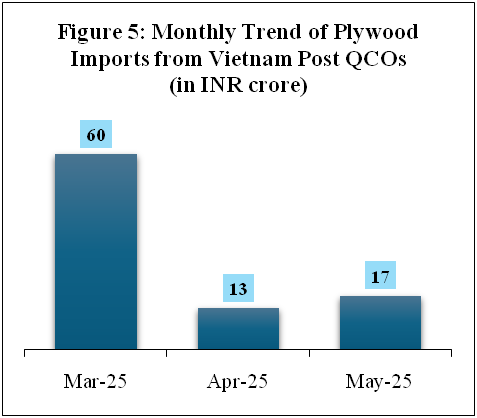
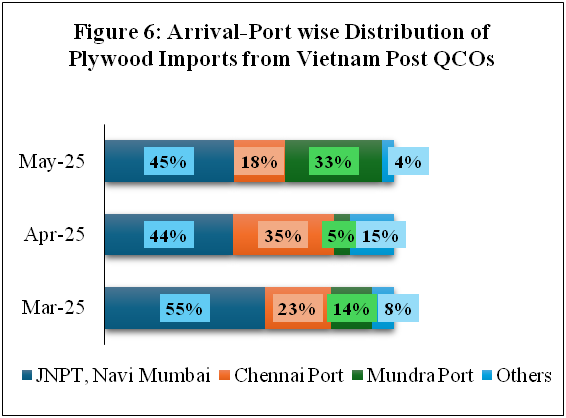
The monthly trend and arrival-port-wise distribution of plywood imports from Vietnam following the implementation of the QCOs are shown in Figures 5 and 6. India imported plywood worth INR 60 crore from Vietnam in March, which declined to INR 13 crore in April and INR 17 crore in May 2025. While plywood imports from Vietnam dropped siginificantly in the post QCOs period, what’s more notable is that no Vietnamese manufacturer has been issued a BIS license for any plywood category.
The arrival-port-wise distribution of plywood imports from Vietnam during the post QCOs period shows that Jawaharlal Nehru Port (Nhava Sheva) in Navi Mumbai emerged as the largest entry point, handling nearly half of the total shipments. Specifically, the port accounted for 55%, 44% and 45% of total plywood volumes arriving from Vietnam in March, April and May 2025, respectively. It was followed by Chennai and Mundra ports, which also became siginificant entry points for Vietnamese plywood after the implementation of the QCOs.
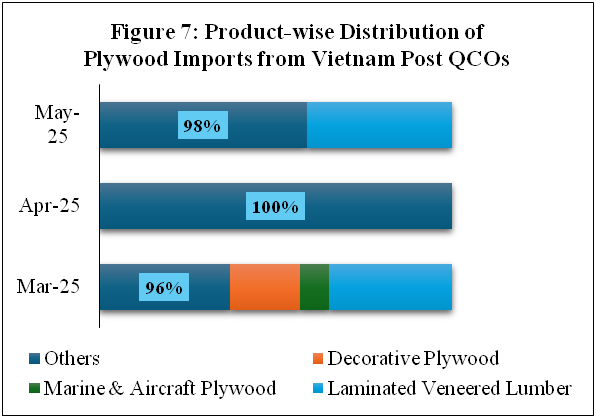
Further, the product-wise distribution of plywood imports from Vietnam after the implementation of the QCOs (as shown in Figure 7) reveals some surprising patterns. Most plywood products entering the Indian market have been classified under the ‘Others’ sub-category of HSN Code 4412. Specifically, 96% of imports in March, 100% in April and 98% in May were classified under this sub-category when exported to India.
The following table lists Vietnam-based companies without BIS licenses whose consignments were cleared at Indian ports after the implementation of the QCOs.
Table 1: List of Vietnam-Based Companies Exporting Plywood to India Without BIS Licenses (Post QCOs Implementation)
| 1. 368 Plywood Import Export Joint Stock Co. | 2. Agritek Co., Ltd | 3. Alphawood Co., Ltd | 4. AMC Vietnam Co., Ltd |
| 5. An Lam Co., Ltd | 6. Asean General Woods Import Export | 7. Asia Vietnam Plywood Co., Ltd | 8. Asian Arowana Import Export Ltd |
| 9. Baifar Langson Co., Ltd | 10. Bao Yen MDF Joint Stock Co. | 11. Benchmark Industries Co., Ltd | 12. Bright Vina Plywood Co., Ltd |
| 13. Công Ty TNHH Plywood C & C | 14. Cuong Linh Wood Joint Stock Co. | 15. D&C Vietnam International Wood Co. | 16. Dung Hang Trading & Manufacturing |
| 17. Fomex Global Joint Stock Co. | 18. H&G Import Export Co., Ltd | 19. Hai Phu One Member Co., Ltd | 20. Hoang Lam Plywood Joint Stock Co |
| 21. Home Products Source Ltd | 22. HPC Holding Co., Ltd | 23. Hung Chang Phu Tho Trading | 24. Hung Dung Hth Production & Trading |
| 25. Hung Hang Phu Tho One Member LLP | 26. Huongson Wood Group Co., Ltd | 27. Innovation Pacific Singapore Pte Ltd | 28. Kego Co., Ltd |
| 29. LIM Company | 30. Longdat Import-Export and Production | 31. Newwood Joint Stock Co. | 32. Son Hung Joint Stock Co. |
| 33. Tekhub Vietnam Joint Stock Co. | 34. Thuan Phat Industrial Wood | 35. Tmv Plywood Viet Nam Co., Ltd | 36. Trieu Thai Son Co., Ltd Truc Mai Phu Tho |
| 37. TT Plywood Import Export & Trading | 38. Upply Minh Phuc Trading | 39. Vietsun 19 Co., Ltd | 40. Vinacamon Joint Stock Co. |
| 41. Western Star Import and Export Co., Ltd | 42. Wood Alliance Investment | 43. Wood Line Co., Ltd | 44. Zhong Sheng Wood Co., Ltd |
The above analysis highlights that despite no plywood manufacturer from Vietnam being issued a BIS license for any category of plywood, Vietnam has emerged as the top source of India’s plywood imports following the implementation of the QCOs. A significant portion of these non-compliant imports are entering the Indian market through Jawaharlal Nehru Port in Navi Mumbai, followed by Chennai and Mundra ports. Furthermore, almost all such imports have been classified under the ‘Others’ sub-category of HSN Code 4412, suggesting that this category is being widely misinterpreted at Indian entry points as exempt from mandatory BIS certification.
2.2.2 Analysis of India’s Plywood Imports Sourced from China Post QCOs
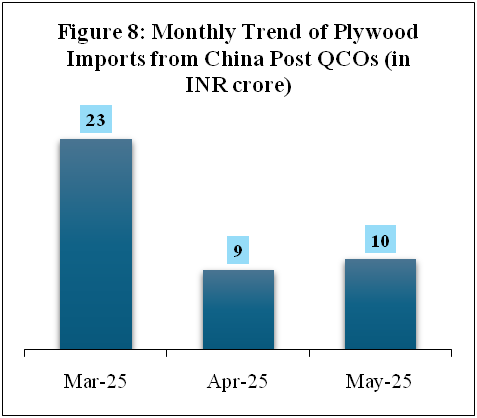
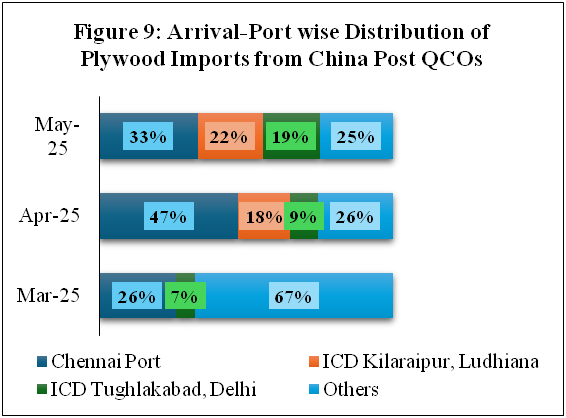
Figures 8 and 9 illustrate the monthly trend and arrival-port-wise distribution of plywood imports from China following the implementation of the QCOs. Consistent with the pattern observed in imports from Vietnam, plywood imports from China also declined in April and May 2025 relative to March. In March 2025, India imported plywood worth INR 23 crore from China, which declined substantially to INR 9 crore in April and INR 10 crore in May 2025. Notably, there are no manufacturers from either Vietnam or China that have been issued BIS licenses for any catgegory of plywood. Despite this, the continued clearance of consignments originating from China raises serious concerns regarding regulatory enforcement and adherence to the mandatory certification requirements.
The arrival-port-wise distribution of plywood imports from China following the implementation of the QCOs indicates that a substantial share of these shipments was handled by Chennai Port, establishing it as the primary entry point for Chinese plywood. Specifically, Chennai Port managed 26%, 47% and 33% of the total shipments from China in March, April and May 2025, respectively. In April and May 2025, Chennai Port was followed by Inland Container Depot (ICD) Kilaraipur, Ludhiana and ICD Tughlakabad, Delhi, both of which handled notable volumes of plywood imports from China.
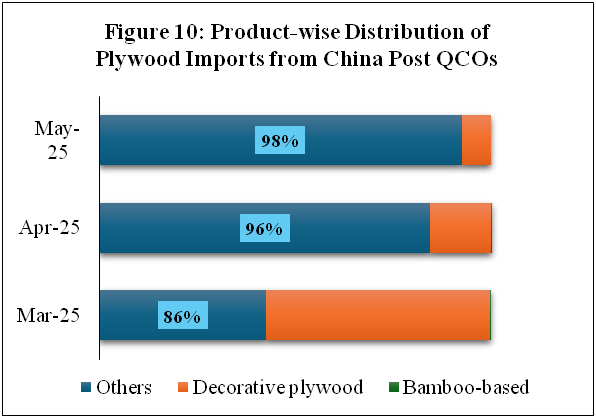
The product-wise distribution of plywood imports from China (as shown in Figure 10) reveals trends similar to those observed in the case of Vietnam. A majority of these imports have been classified under the ‘Others’ sub-category of HSN code 4412. The share of this sub-catgeory in total plywood imports from China increased steadily month-over-month, reaching 98% in May 2025, up from 86% in March and 96% in April. This persistent reliance on the ‘Others’ sub-category raises concerns about potential misclassification and circumvention of mandatory BIS certification requirements.
The following table provides a list of China-based companies that have not been issued BIS licenses, yet whose consignments were cleared at Indian ports after the implementation of the QCOs.
Table 2: List of China-Based Companies Exporting Plywood to India Without BIS Licenses (Post QCOs Implementation)
| 1. Accahome Ltd | 2. Beijing Graphic International Trade | 3. Dalian Amuer Co., Ltd | 4. Dalian Jiaen Meike Wood Industry Co., Ltd |
| 5. Dalian Maishun Wood Industry Co., Ltd | 6. Durafloor Werner Gmbh | 7. Gold Seagull Shanghai Flooring Company | 8. Hang Sam International Co., Ltd |
| 9. Hangzhou Zen Bamboo & Hardwood Products | 10. Heze Ruidu International Trade | 11. Htl Import Export Trading Kunshan Co., Ltd | 12. Huzhou Jonhos Creative Home Co., Ltd |
| 13. Huzhou ShitoHomie Co., Ltd | 14. Huzhou Teya Floor Co., Ltd | 15. Huzhou Weiya Trading Co., Ltd | 16. Infinite Grace Co., Ltd |
| 17. Jesonwoood Forest Products (zj) Co., Ltd | 18. Jiaxing Frank International Co., Ltd | 19. Jining Floormaker Co., Ltd | 20. Langfang Lanxing Impex Co., Ltd |
| 21. Lianyungang Chanta International Wood | 22. Lianyungang Yuantai International Trade | 23. Linsen Railway Vehicle Components Co., Ltd | 24. Linyi Bait Wood Industry Co., Ltd |
| 25. Linyi Chunchang International Trade | 26. Linyi Consmos Wood Industry Co., Ltd | 27. Linyi Haishun Import and Export Co., Ltd | 28. Linyi Heyuanming International Trading |
| 29. Linyi Huanhai International Trade | 30. Linyi Huifu International Trade | 31. Linyi Jingxinda International Trade | 32. Linyi Leberg International Trade |
| 33. Linyi Powerade Wood Co., Ltd | 34. Linyi Rongchen Import & Export Co., Ltd | 35. Linyi United International Trading | 36. Linyi Weihang International Trade |
| 37. Linyi Wells Import & Export Co., Ltd | 38. Linyi Xingtan Building Materials Co., Ltd | 39. Max Choice Wood Industry Co., Ltd | 40. Shandong Changsen Import & Export Co., Ltd |
| 41. Shandong Kaiyuan Wood Industry Co., Ltd | 42. Shandong King Kong Industry Co., Ltd | 43. Shandong Ruitai Import & Export Trade | 44. Shandong Suraj International |
| 45. Shandong Yimai International Trade | 46. Shanghai Glorious International Co., Ltd | 47. Suqian Sulu Import & Export Trading Co., Ltd | 48. Weifang Suntop Import & Export Co., Ltd |
| 49. Win Top Enterprises Ltd | 50. Xuzhou Emmet Import & Export Trading | 51. Xuzhou Huanghuai Co., Ltd | 52. Xuzhou Shenghe Wood Co., Ltd |
| 53. Yalong New Material Shandong Co., Ltd | 54. Yiyuan Great Hawk Wood Co., Ltd | 55. Zhaoqing Yaodonghua Decor Materials | 56. Zhejiang Guolian Floor Co., Ltd |
The above analysis of plywood imports from China following the implementation of the QCOs reveals that, despite no Chinese plywood manufacturer having been issued a BIS license for any category of plywood, China emerged as the second-highest source of India’s plywood imports – second only to Vietnam. A substantial portion of these consignments has entered the Indian market through Chennai Port, followed by ICD Kilaraipur (Ludhiana) and ICD Tughlakabad (Delhi). Consistent with the trend observed in the case of Vietnam, nearly all plywood imports from China have been classified under the ‘Others’ sub-category of HSN Code 4412. This pattern strongly suggests that exporters may be misuing this sub-catgeory to circumvent mandatory BIS certification and facilitate the entry of non-compliant plywood into the Indian market.
2.2.3 Analysis of India’s Plywood Imports Sourced from Nepal Post QCOs
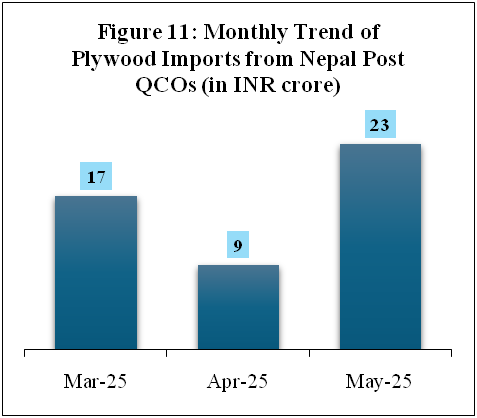
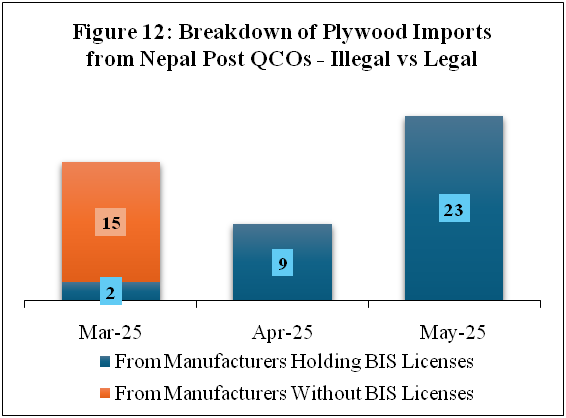
The monthy trend of total plywood imports from Nepal, along with their classification into legal and illegal segments, is presented in Figures 11 and 12. Illegal imports are defined as those originating from manufacturers that do not hold BIS licenses, while legal imports refer to consignments from BIS-certified manufacturers, following the implementation of the QCOs.
After the QCOs came into effect, plywood imports from Nepal stood at INR 17 crore in March, declined to INR 9 crore in April and then rose sharply to INR 23 crore in May 2025. A detailed breakdown reveals that in March, of the total import value of INR 17 crore, INR 15 crore worth of consignments originated from 30 manufacturers lacking BIS certification. However, in April and May, imports from non-BIS-certified manufacturers ceased entirely and all consignments were sourced from just 9 BIS-certified manufacturers.
The sharp rise in export value from the same set of 9 BIS-certified manufacturers – from INR 2 crore in March to INR 23 crore in May 2025 – raises significant concerns.
The following tables separately list Nepalese plywood manufacturers who have been granted BIS licenses and those who have not.
Table 3: List of Nepalese Plywood Manufacturers Holding BIS Licenses
| 1. Ambey Bhawani Ply Board UdhyogPvt. Ltd. | 2. Bhusal Ply & Bamboo Industries | 3. Century Ply Industries Pvt. Ltd. | 4. Everest Veneers Pvt. Ltd. |
| 5. Ganpati Veneer Tatha Plywood Udhyog | 6. Greenply Industries Nepal Pvt. Ltd. | 7. Jhapa Veneer & Plywood Udhyog | 8. Sawariya Plywood Pvt. Ltd. |
| 9. Shyam Plywood Industries Pvt. Ltd. |
Table 4: List of Nepalese Plywood Manufacturers Who Exported Plywood to India Without BIS Licenses in March 2025
| 1. Annapurna Plywood Udhyog | 2. Apurva Ply Industry Pvt. Ltd | 3. Asian Plywood Industries Pvt. Ltd | 4. Bhagwati Laminates Pvt. Ltd |
| 5. Himshikhar Laminate & Kastha | 6. Jaya Bajaranga Plywood Industries | 7. Jaya Maa Kamakhya Industries Pvt. Ltd | 8. Kankai Plywood Industries |
| 9. Kohinoor Plywood Industries Pvt. Ltd | 10. Mata Pathivara Plywood Industry | 11. Namaste Plywood Industries Pvt. Ltd | 12. Nepal Veneer Udhyog |
| 13. Om Wood Products Pvt. Ltd | 14. Pashupati Plyboard UdhyogPvt. Ltd | 15. Pathivara Veneer & Plywood Industries | 16. Riddhi Siddhi Plywood Industries |
| 17. Sanjibani Plywood UdhyogPvt. Ltd | 18. Sarawagi Plywood Industries | 19. Shakambhari Plywood Industries | 20. Shiva Shakti Wood Pyanal Industries |
| 21. Shree Jagdamba Plyboard Industries | 22. Shree Ply Industries Pvt. Ltd | 23. Siddhartha Plywood Industries Pvt.Ltd | 24. Siddhi Binayak Plywood Industries |
| 25. Sriram Panel Product Pvt.Ltd | 26. Sungreen Plywood Industries Pvt. Ltd | 27. Sunsari Veneers Pvt. Ltd | 28. Surya Tea Chest Industries |
| 29. Tirupati Wood Panel Industries | 30. Venkatesh Wood Panel Industries |
Exporter-wise import data of May 2025 from Nepal to India show an abnormal surge in plywood volumes exported by BIS-certified plywood manufacturers from Nepal. Most of these manufacturers recorded a multi-fold increase in their export figures to India in May, compared to the trend observed during the January to April 2025 period. The following table presents the monthly plywood export volumes (in thousands of square meters) from Nepalese manufacturers holding valid BIS licenses.
Table 5: Monthly Plywood Export Volumes (in thousands of square meters) from BIS-Certified Nepalese Manufacturers to India (Jan – May 2025)
| BIS-Certified Nepalese Manufacturers | Jan – Feb 2025 | March 2025 | April 2025 | Jan-Apr Combined | May 2025 | May Exports Compared to Jan-Apr Average (in Multiples) |
| Ambey Bhawani Ply Board Udhyog | 48 | 56 | 44 | 148 | 131 | 4 times |
| Bhusal Ply & Bamboo Industries | 13 | 0 | 115 | 128 | 70 | 2 times |
| Century Ply Industries Pvt. Ltd. | 9 | 10 | 64 | 83 | 69 | 3 times |
| Everest Veneers Pvt. Ltd. | 13 | 8 | 21 | 42 | 35 | 3 times |
| Ganpati Veneer Tatha Plywood Udhyog | 19 | 0 | 0 | 19 | 204 | 43 times |
| Greenply Industries Nepal Pvt. Ltd. | 37 | 5 | 31 | 73 | 46 | 2 times |
| Jhapa Veneer & Plywood Udhyog | 25 | 13 | 77 | 114 | 386 | 14 times |
| Sawariya Plywood Pvt. Ltd. | 20 | 23 | 66 | 109 | 148 | 5 times |
| Shyam Plywood Industries Pvt. Ltd. | 37 | 3 | 51 | 91 | 122 | 5 times |
The above analysis highlights that despite the implementation of the QCOs in February 2025, most of the plywood imports from Nepal in March 2025 originated from manufacturers lacking BIS licenses. Furthermore, the abnormal surge in exports from Nepal-based manufacturers holding BIS licenses in May 2025 indicates a strong possibility that non-BIS-compliant plywood from Nepal is entering India under the cover of certified material. It appears that manufacturers holding BIS licenses are misusing their licenses to facilitate the entry of illegal plywood of non-BIS manufacturers into India, thereby undermining the primary objective of the QCOs.
MDF & PARTICLE BOARD
3. Analysis of MDF& Particle Board Imports Following the Implementation of the QCOs
3.1 Monthly Trends in MDF & Particle Board Imports to India
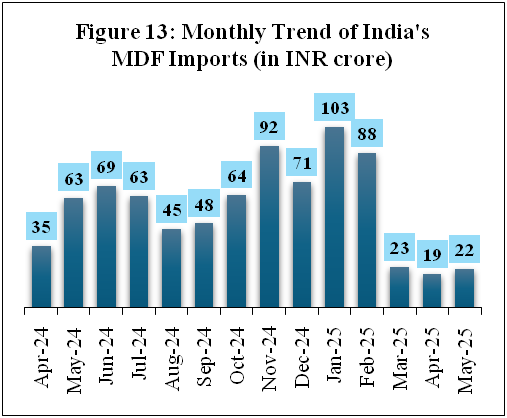
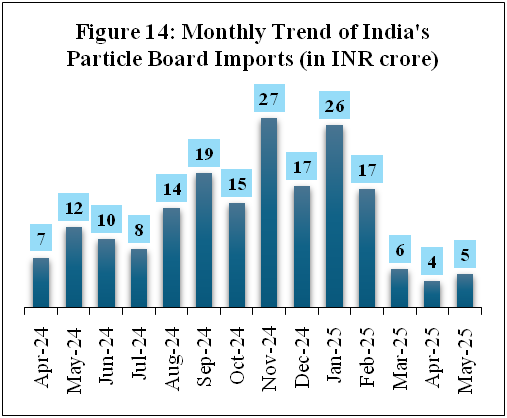
Figures 13 and 14 present the month-wise trend analysis of India’s imports of medium-density fibreboard (MDF) and particle board. Just prior to the implementation of the QCOs, MDF imports stood at INR 88 crore in February 2025. This value declined siginificantly to INR 23 crore in March, followed by INR 19 crore in April and INR 22 crore in May 2025. A similar downtrend was observed in the particle board segment. Imports of particle board amounted to INR 17 crore in February, decreasing to INR 6 crore in March, INR 4 crore in April and INR 5 crore in May 2025.
3.2 Major Source Countries for India’s MDF & Particle Board Imports in the Post QCOs Era
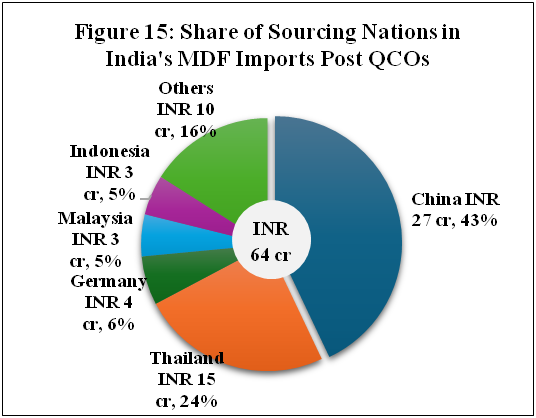
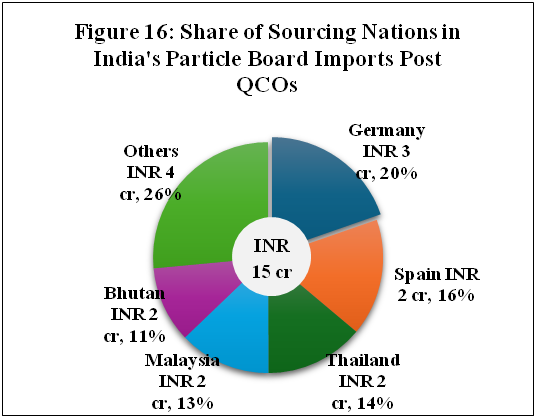
The source-country-wise distributions of India’s MDF and particle board imports during the post-QCOs period (March, April and May 2025 combined) are shown in Figures 15 and 16.
Following the implementation of the QCOs, China emerged as the leading source country for India’s MDF imports, contributing 43% of the total import value – amounting to INR 27 crore. Other major source countries included Thailand, Germany, Malaysia and Indonesia.
In the particle board segment, Germany became the top source country, exporting particle board worth INR 3 crore to India, which accounted for 20% of the total import value during the three-month period. Spain, Thailand, Malaysia and Bhutan also held significant shares in India’s particle board imports.
In terms of BIS compliance, only two foreign manufacturers – one from Thailand and one from Malaysia – were issued BIS licenses for MDF following the implementation of the QCOs. Despite China being the top source country for India’s MDF imports, no Chinese manufacturer has been granted a BIS license, indicating that non-BIS-compliant MDF continues to enter the Indian market post QCOs implementation. For particle board, the compliance situation is more concerning. As of May 2025, no foreign manufacturer had been issued a BIS license for particle board yet imports worth INR 15 crore were recorded during the post-QCOs period. This indicates the continued entry of non-compliant products and highlights the urgent need for stricter enforcement mechanisms.
4. Conclusion & Way Forward
The examination of India’s plywood and panel imports following the implementation of the QCOs reveals significant gaps in regulatory compliance. At first glance, the decline in import volumes suggests that the QCOs have been effective in restricting the entry of non-compliant products. However, a closer analysis indicates that substantial quantities of non-compliant plywood and panel products continue to enter the Indian market.
In the plywood segment, despite the mandatory BIS certification introduced in February 2025, a considerable volume of non-compliant plywood continues to enter India. Notably, no plywood manufacturer from key source countries such as Vietnam and China holds a BIS license for any category of plywood. Imports from Vietnam predominantly arrived via Jawaharlal Nehru Port of Navi Mumbai, while those from China primarily entered through Chennai Port. Moreover, all such imports have been classified under the ‘Others’ sub-category, which appears to be misinterpreted as exempt from mandatory BIS certification at Indian ports.
Similar trends are observed in the MDF and particle board segments, where imports continue from foreign manufacturers lacking BIS licenses. These developments undermine the purpose of the QCOs, place compliant domestic manufacturers at a significant disadvantage and expose consumers to potential risks from non-certified materials.
To address these challenges, it is imperative to strengthen collaboration between customs authorities and the BIS, enhance inspection procedures at Indian ports and conduct regular audits of imported consignments. Such measures are essential to fully realize the intended impact of the QCOs and ensure the quality and safety of plywood and panel products in the Indian market.