For many years, the Indian furniture manufacturing community has consistently highlighted acritical gap in the availability of engineered panels—materials that can reliably withstand highmoisture exposure while maintaining dimensional stability and mechanical strength. This need has
been particularly evident in applications such as kitchens, bathrooms, and coastal installations,where conventional boards often fall short over time.
As furniture design in India evolves toward modular systems, precision manufacturing, and longerservice life expectations, the demand for high-performance substrates has only intensified. In thiscontext, the emergence of Boiling Water Proof (BWP) High-Density Fibreboard (HDF)represents a significant and timely development for industry.
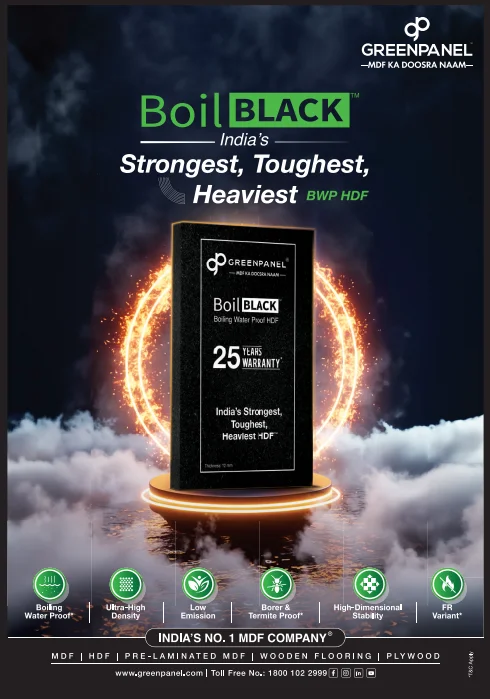
Recent advancements, including those by Greenpanel Industries Ltd., indicate that the industry isactively responding to this long-standing requirement with solutions that combine strength,stability, and moisture resistance in a single panel.
Why the Industry Needed a Shift: Furniture manufacturers across India have traditionally worked with MDF, particleboard, and plywood, each offering its own advantages. However, a persistent challenge has been achieving a balance between: (a) High strength and screw holding capacity (b)
Resistance to moisture and swelling (c) Dimensional stability over time (d) Consistency in machining and finishing
In high-humidity conditions or moisture-exposed applications, conventional MDF andparticleboard tend to exhibit swelling and loss of strength, while plywood—though moistureresistant—often presents limitations in surface uniformity and machining precision.
This gap has led to a continuous search within the furniture community for a material that canbridge these performance limitations without compromising process efficiency.
What Makes BWP HDF Different: BWP-grade HDF addresses these challenges through acombination of high density (~1100 kg/m3) and enhanced resin technology. The result is a panel with a highly compact fibre structure and strong internal bonding.
For furniture manufacturers, this translates into: (a) Superior screw holding strength, especially at edges (b) Improved load-bearing capacity for structural components (c) Reduced deformation during machining and service
Such characteristics are particularly relevant for modular furniture systems, where precision and repeatability are essential.
Performance in Moisture-Prone Applications: One of the most significant advantages of BWP HDF is its ability to withstand severe moisture exposure, including boiling water conditions. This is a critical improvement for applications where panels are exposed to: (a) High humidity (b)
Intermittent water contact (c) Temperature fluctuations
The dense fibre network, combined with a robust resin matrix, helps in: (a) Minimizing water absorption (b) Reducing thickness swelling (c) Maintaining structural integrity over time
For furniture manufacturers, this means fewer failures, improved product reliability, and better customer satisfaction in real-world conditions.
Dimensional Stability: A Practical Advantage: In practical applications, dimensional stability is
as important as strength. Warping, cupping, and joint failure are common issues faced in moisture- sensitive environments.
BWP HDF demonstrates strong resistance to such issues, maintaining its form even under cyclic wet–dry conditions. This stability is particularly valuable in: (a) Modular kitchen components (b) Bathroom vanities (c) Large panel shutters and partitions
It ensures that finished products retain their alignment and functionality over extended periods.
Processing Benefits for Manufacturers: Beyond performance in service, ease of processing remains a key consideration for the furniture industry. High-density HDF offers: (a) Smooth and uniform surfaces for lamination and coating (b) Consistent behaviour in CNC machining (c) Reduced fibre
tear-out and edge defects
Additionally, developments such as uniform core structures (including darker core variants) support better edge aesthetics, which is increasingly important in modern furniture design.
A Material Aligned with Industry Evolution: The Indian furniture sector is rapidly transitioning toward: (a) Factory-made modular furniture (b) Automated and CNC-based production (c) Higher quality benchmarks and durability expectations
Materials like BWP HDF align well with this transformation by offering both performance reliability and manufacturing efficiency.
Conclusion: The introduction of Boiling Water Proof High-Density Fibreboard marks a meaningful step forward in addressing a long-standing requirement of the Indian furniture industry. By combining high density, moisture resistance, and dimensional stability, it offers a practical solution
to challenges that manufacturers have faced for years.
As the industry continues to evolve, such advancements are expected to play a crucial role in improving product quality, reducing failure rates, and enabling furniture manufacturers to confidently meet the growing expectations of end users.