
Birch-Faced Plywood by Greenply
 May 15, 2026
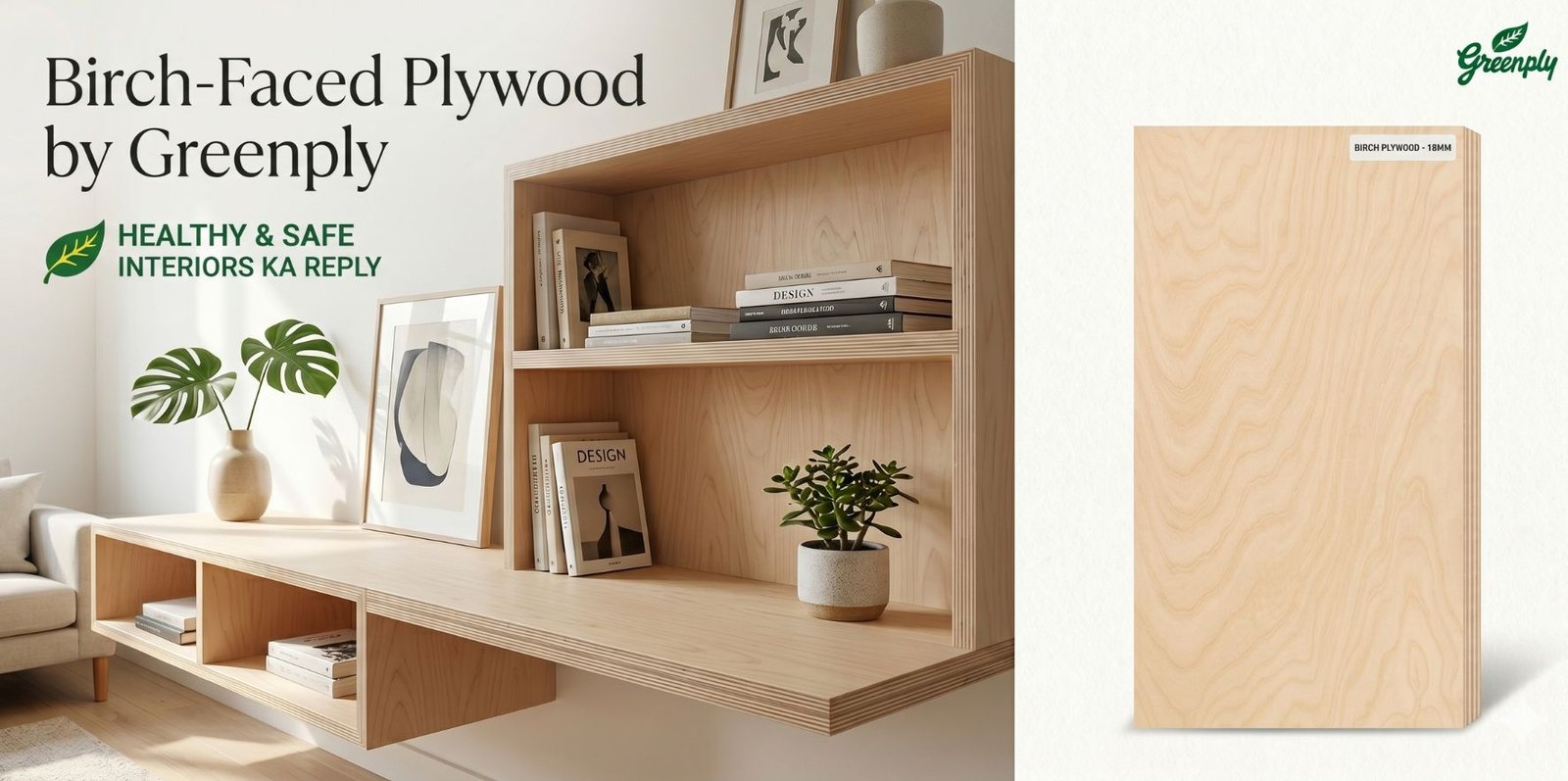
The introduction of BIS Quality Control Orders (QCO) for wood panel products, including imported materials, created a significant shift in the Indian furniture and OEM landscape. A clear requirement emerged from import-dependent segments, where manufacturers and designers were relying on imported birch plywood for its superior aesthetics and performance, but now faced challenges in compliance, availability, and continuity of supply.
To address this evolving situation, Greenply has introduced a new Birch-Faced Plywood range, engineered to deliver high precision, aesthetically superior surfaces, and excellent dimensional stability. This development provides a practical and reliable solution aligned with Indian regulatory frameworks.
At the same time, furniture OEMs and interior solution providers were seeking a panel that could offer European-style birch aesthetics, consistent dimensional performance, and low formaldehyde emissions (E0–E1 levels), while being manufactured under Indian conditions, standards, and service support systems.
It is important to note that there is currently no separate BIS standard specifically defined for birch-faced plywood. However, Greenply’s Birch-Faced Plywood is developed in compliance with existing standards such as IS: 303 (General Purpose Plywood) and IS: 710 (Marine Grade Plywood), depending on the bonding requirement and IS: 1328 for decorative and aesthetic performance, based on buyer-specific requirements.
Greenply’s Birch-Faced Plywood thus effectively bridges the gap by offering a product with BIS-compliance value and locally manufactured alternative to imported panels, without compromising on design, quality, performance, or evolving standardization needs.
Product Details – Raw Materials, Paper, and Base Ply
Birch-faced plywood from Greenply uses carefully selected birch face veneers sourced to meet decorative grade norms typically equivalent European face grades, which allow minimal knots and a clean, uniform appearance. The thickness of Birch face veneer is 0.30mm. The used base plywood is calibrated with tolerance of +/- 0.20mm.
The base ply is composed of multiple cross-bonded layers of plantation hardwood or softwood veneers, selected for density, strength, and stability rather than traditional species names, in line with industry recommendations to define core by properties. High-performance synthetic resins are used to achieve water-resistant or boiling-water-proof bonding, depending on the targeted application.
Product Testing and Performance Values
During development, the birch-faced plywood was evaluated for key performance parameters in line with BIS guidelines and industry best practices for decorative panels. Typical tests include:
- Glue shear strength in dry and wet conditions to verify bond quality against IS:1328/IS 303/IS 710 requirements.
- Water resistance through 24-hour water immersion and, for higher grades, cyclic boiling tests, to establish suitability for interior and semi-wet applications.
- Mechanical properties such as MOR and MOE in both parallel and perpendicular directions to confirm load-bearing capability and resistance to bending in furniture use.
- Dimensional stability checks – thickness swelling, water absorption, and linear expansion – to ensure minimal movement and better performance in India’s variable climate.
- Formaldehyde emission tests aligned with E0/E1 targets to meet health-focused market segments and export-oriented specifications.
In Greenply’s internal development, these test results were used to optimise core construction, veneer lay-up, and adhesive formulation so that the birch-faced panels not only deliver decorative value but also match the strength and durability expected from premium structural plywood.
Size and Thickness Availability
To suit both Indian and international project requirements, Greenply’s birch-faced plywood is offered in standard panel sizes commonly used in furniture and interior fit-outs. Typical sizes include 2440 mm × 1220 mm (8 ft × 4 ft), with the possibility of additional dimensions such as based on market demand.
The thickness range is calibrated to cover light furniture components as well as heavier structural applications, aligning with prevalent industry practices. Representative thicknesses include 16/18 mm, with tighter tolerance control to support CNC machining, edge profiling, and precise joinery.
Key Advantages:
- Minimum thickness variations for precision work
- Ideal for CNC cutting, edge banding, and modular furniture
- Consistency across panels for large-scale projects
Additional sizes and thicknesses can be developed based on project-specific or market requirements.